Let’s begin by exploring a subject that goes beyond the physical world itself. We’re going to take a step beyond our normal four dimensions to talk about what we call the Godhead: one God found in three distinct Persons.
There are many critics who argue that there’s a basic absurdity involved in trying to say “one is three and three is one,” but there really is no absurdity involved if we are contending that plurality can coexist with unity. Here’s an example.
When Adam and Eve came together, they became “one flesh.” The equation for this would be 1+1=1. That may be bad math, but it demonstrates how a plurality can form a unity.
We can go a little deeper and see how even the structure of the original languages in the Bible were used to make this point.
God the Singular – Echad
The Hebrew word for “one” is דחָאֶ —‘echad—while the Hebrew word for “sole” or “unique” is דיִחיָ —yachiyd.
Going back to Adam and Eve in Genesis 2:24, ‘echad is used in the term “one flesh.” ‘Echad allows Adam to be distinguished from Eve while they are spoken of as “one.” Their unity is being emphasized according to the grammar, the very linguistic structure of the words.
In the Sh’ma itself, the word for “one” is ‘echad. “Hear, O Israel, the LORD our God is one [‘echad] LORD, and thou shalt love the LORD thy God with all thy heart, and with all thy soul and with all thy might.” Jesus even quotes this passage in Matthew 22 when He is asked about the greatest commandment.
This whole concept of being one, or unique, is emphasized by God Himself repeatedly in about 150 references, including the Ten Commandments: “Thou shalt have no other Gods before me.”
We’re not going to examine them all, but consider a few:
And the LORD shall be king over all the earth: in that day shall there be one LORD, and his name one.
Zechariah 14:9
Thou, even thou, art LORD alone; thou hast made heaven, the heaven of heavens, with all their host, the earth, and all things that are therein, the seas, and all that is therein, and thou preservest them all; and the host of heaven worshippeth thee.
Nehemiah 9:6
In Isaiah, we find an unusual letter that God drafted to Cyrus—by name—over a century before this great Persian king was born.
Long before the Babylonians destroyed Jerusalem, God tells Cyrus that he will rebuild Jerusalem and lay the foundations for the Temple (Isaiah 44:28). When Cyrus the Great ultimately does read the prophecy after he conquers Babylon, he takes it seriously, and he turns the Jews loose to go home, as described in 2 Chronicles 36:22-23 and Ezra 1.
As part of Isaiah’s letter to Cyrus (again, written more than a century before this Persian king’s birth) God makes some major assertions about His own nature and character, beginning with verse five:
“I am the LORD, and there is none else, there is no God beside me: I girded thee, though thou hast not known me: that they may know from the rising of the sun, and from the west, that there is none beside me. I am the LORD, and there is none else.”
Isaiah 45:5-6
Look unto me, and be ye saved, all the ends of the earth: for I am God, and there is none else. I have sworn by myself, the word is gone out of my mouth in righteousness, and shall not return, That unto me every knee shall bow, every tongue shall swear.
Isaiah 45:22
These are just a few of many passages that emphasize that God is One, unique, singular and very jealous of that position. In fact, in the middle of the Ten Commandments, He says, “I, the Lord thy God, am a jealous God.” He uses that term, maybe in a very special way, but He uses the term “jealous.”
God the Plurality – Elohim
God emphasizes His unique character in the Universe, His role as the only LORD, the only Creator. This emphasis does not, however, exclude a plurality within that unity. The Scriptures are full of implications that the One God is more than one Person, beginning with the very first verse of the Bible.
The Bible opens with seven words, using 28 letters in the Hebrew: “Beresheet bara Elohim et hashamayim ve’et ha’arets.”

In the beginning, God created the heavens and the earth.
Genesis 1:1
This is an important, exciting verse. We could devote an entire book to Genesis 1:1 and the discoveries that have been made about the specific letters laid out in this one verse. We must not get distracted from our central purpose, though, so we’ll focus on a couple of critical things.
The ancient Hebrew writers recognized that the word beresheet, “in the beginning,” meant the beginning of time and space, not just the beginning of matter and energy. That’s a contemporary insight from the point of view of modern physics even though it was first recorded in the Hebrew Talmudic tradition by Nachmanides in the 12th century.
The word “created” in this verse is bara, a word that emphasizes creation from nothing. According to the Parity Principle in physics, all particles have a counter-particle; electrons are balanced by positrons, neutrinos are countered by antineutrinos.
These particle-antiparticle pairs destroy each other on contact, shooting off gamma rays as they do, and it’s as though the Universe were built out of “nothing” split into combination pairs.
The Charge Parity is approximate and not perfectly symmetrical here from our vantage point, otherwise the matter-antimatter pairs would utterly annihilate each other and we would all soon cease to exist. We were created out of nothing when God—bara—called it all into existence.
Through faith we understand that the worlds were framed by the word of God, so that things which are seen were not made of things which do appear.
Hebrews 11:3
This brings us to the word Elohim, a noun that takes the plural “im” ending but uses verbs conjugated in the singular. The word for “god” in Hebrew is el or eloah, and the plural form is Elohim. The noun and verb have to agree in most languages, often more rigorously than in
the English.
Elohim is plural, and yet, the word bara is a singular verb. In fact, every place Elohim occurs in reference to the God of Israel, we find the grammatical error of a plural noun used with a singular verb. When we understand the Hebrew grammar, it becomes apparent that we have a situation that throws us off within the first few words of Genesis.
If we look carefully, we can gain a subtle insight about the nature of this God who created the worlds from nothing. The Hebrew plural of this one God surfaces in a number of places even through the English translation. However, it could also imply something about God’s own plurality within one Being.
“Let Us”
And God said, Let Us make man in Our image, after Our likeness: and let them have dominion over the fish of the sea, and over the fowl of the air, and over the cattle, and over all the earth, and over every creeping thing that creepeth upon the earth.’”
Genesis 1:26
Notice that it says here, “God said, ‘Let us…’” Who is God talking to? Some theologians suggest that He could have been talking to the angels, but the angels didn’t participate in the Creation itself.
Job 38:7 tells us the sons of God shouted for joy when God stretched the foundations of the Earth, but the first chapter of Hebrews makes a clear distinction between God’s work as Creator and the position of angels as ministering spirits. What’s more, human beings were not made in the image of angels.
Yet, in Genesis 1, God says, “Let us make man in Our image.”
Let’s go over to Genesis 3, where Adam and Eve are about to be expelled from Eden:
And the LORD God said, Behold, the man is become as one of Us, to know good and evil…
Genesis 3:22
Again, God speaks of Himself in the plural. This happens often enough that we should not dismiss it as just an idiom, or a figure of speech or a rhetorical convenience. We should notice the consistent pattern that’s been given us.
The Tower of Babel
A few chapters later in Genesis 11, we read about the famous Tower of Babel event, in which the people united in rebelling against God and made a monument to that effect.
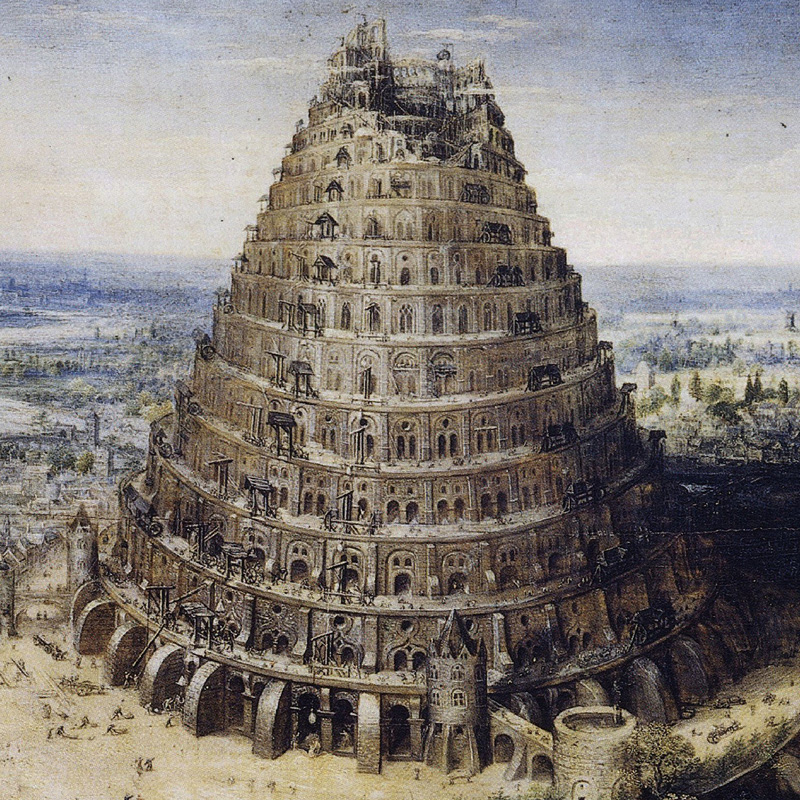
God therefore declares:
Go to, let Us go down, and there confound their language, that they may not understand one another’s speech.
Genesis 11:7
“Let Us go down.” Once again, the Hebrew is plural, as though God were talking to other persons present with Him. There are a few places where translators cannot escape this peculiarity of plural pronouns used for the Godhead.
We therefore have one God, yet even in the linguistic structure we have hints of a plurality.
Harmony in Plurality
Psalm 2
Based on our own experiences, most of us assume that where there is plurality, there is dissention. Yet, in the Godhead there is perfect unity; all three Persons of the Trinity move together in complete harmony.
It is easy to fall into error regarding the nature of these Three. Some people see the Trinity as three modes of the same Person, three different hats that God wears at different times. That’s a big mistake, because each member of the Trinity has His own distinct identity. Throughout Scripture, we consistently find all three members of the Trinity mentioned as God, yet acting and speaking as distinct from one another.
One of the most interesting examples of this plurality is found in the second Psalm, where all three Persons of the Trinity speak back and forth to each other.
Why do the nations rage, and the peoples imagine a vain thing? The kings of the earth set themselves, and the rulers take counsel together, against the LORD, and against His Anointed…
Psalm 2:1-2
“The rulers take counsel together against the LORD,” and against who else? Against His Anointed. The Hebrew word for “anointed” is mashiach—the Messiah. In other words, Psalm 2:1-2 states that the nations are raging against the LORD and His Messiah. And what are these rulers saying?
Let us break their bands asunder, and cast away their cords from us.
Psalm 2:3
Notice the plural; “Let us break their bands…” Not His bands,
but “Their bands.” Then we have an editorial comment added here in verses 4-6.
He that sitteth in the heavens shall laugh: the Lord shall have them in derision. Then shall He speak unto them in his wrath, and vex them in his sore displeasure. “Yet have I set my king upon my holy hill of Zion.”
Psalm 2:4-6
There is laughter at the throne of God. At whom? He is laughing at the world leadership for their presumption and arrogance. He goes on to address them in His displeasure, and He informs them that His Messiah will rule on Zion whether they like it not. Then He says something remarkable:
I will declare the decree: the LORD hath said unto me, Thou art my Son; this day have I begotten thee. Ask of Me, and I shall give thee the heathen for thine inheritance, and the uttermost parts of the earth for thy possession. Thou shalt break them with a rod of iron; Thou shalt dash them in pieces like a potter’s vessel.
Psalm 2:7-9
This is the second Psalm, written by David. Yet, we find out the identity of the King who rules with a rod of iron in Revelation 19:13-16. He is the King of Kings and Lord of Lords, and He is called the “Word of God.” In John 1:1-3, we find out that the Word of God was in the beginning with God and all things were created through Him. We learn that He became flesh and dwelt among us (John 1:14).
The book of Revelation is filled with picture codes, but all of those codes are explained somewhere else in the Scripture. This makes a very convincing case that these 66 books, written by 40 authors over thousands of years, are an integrated message system, supernaturally engineered from outside our time domain.
The Baptism
We find the three members of the Trinity speaking in Psalm 2, but we also find them together at the Baptism of Jesus Christ.
And Jesus, when he was baptized, went up straightway out of the water: and, lo, the heavens were opened unto him, and he saw the Spirit of God descending like a dove, and lighting upon him: And lo a voice from heaven, saying, This is my beloved Son, in whom I am well pleased.
Matthew 3:16-17
In the space of two verses, we see Jesus baptized, the Holy Spirit rest on Him, and God the Father calling Jesus Christ His beloved Son—all three members of the Trinity portrayed separately at the same moment in Time.
The Temptation
In Psalm 2, we read, “Ask of me, and I shall give Thee the nations for Thine inheritance, and the uttermost parts of the earth for Thy possession.”
Now you may recall that immediately after the baptism of Jesus Christ, He entered into the period we call the temptations, where Satan tempted Him.
Three specific temptations were described in the Gospels, both in Matthew 4 and Luke 4. At one point, Satan manages to take Jesus up to a mountaintop where he shows Him all the nations of the world, Luke 4:5 says, “in a moment of time.” There Satan made the claim, “They’re mine, and I can give them to whomsoever I will.”
Satan is not making an empty boast, or else there would be no temptation involved. If a fellow walked up to me and wanted to sell me the Brooklyn Bridge, I wouldn’t be tempted to purchase it because I’d doubt the guy had the right to sell it.
Jesus doesn’t challenge the premise of Satan’s offer, and that’s profound. John 16:11 states that the “prince of this world” is judged, implying that Satan is the prince of this world, and Paul calls Satan “the god of this world”(2 Corinthians 4:4).
Who rules this world? Satan does. Who owns the media? Satan does.
Satan was offering Jesus a shortcut. “Why go by way of the Cross when you can do it the easy way? I can give you all the nations.” That’s an interesting study in its own right.
Avenger of Blood
Yet, in Psalm 2, God promises His anointed one, His Meshiach, that He will call Him “Son” and will give Him the nations. Again, in
Psalm 2:9 we read: “Thou shalt break them with a rod of iron. Thou shalt dash them in pieces like a potter’s vessel.” As mentioned, this “rod of iron” terminology links this passage with the book of Revelation.
Psalm 2 finishes with a warning:
Be wise now therefore, O ye kings: be instructed, ye judges of the earth. Serve the LORD with fear, and rejoice with trembling. Kiss the Son, lest he be angry, and ye perish from the way, when his wrath is kindled but a little. Blessed are all they that put their trust in him
Psalm 2:10-12
Many people see Jesus Christ as a suntanned carpenter who walked the shores of Galilee, patting kids on the head and telling everyone to turn the other cheek. They are in for a surprise. Jesus is certainly our Goel, our kinsman redeemer who came to rescue us. The other duty of the position of the Goel, though, is his role as the avenger of blood. Our God is longsuffering, but in His love He is just, and He will not let evil reign forever.
It is worthwhile to read Psalm 2 carefully and determine exactly Who is speaking to Whom in each line. We find right here a conversation between the Father, the Son and the Holy Spirit, as all three members of the Trinity talk back and forth and reveal to us a piece of God’s plan for the planet Earth.
This was adapted from Chuck Missler’s book The Trinity: The Mystery of the Godhead.
Also available in a two hour audio presentation.
http://store.khouse.org